
Coronavirus disease (COVID-19): Vulnerable populations and COVID-19
This document from the Public Health Agency of Canada describes populations that are most at-risk of contracting COVID-19 and how to address inequities.

This document from the Public Health Agency of Canada describes populations that are most at-risk of contracting COVID-19 and how to address inequities.

Dans son rapport annuel publié en décembre 2019, l’administratrice en chef de la santé publique du Canada souligne que la stigmatisation exacerbe les iniquités de santé au Canada. L’information présentée dans le rapport est tirée des propos tenus lors des rencontres avec des informateurs clés des quatre coins du Canada pour débattre des questions suivantes : Qu’est-ce qui maintient la stigmatisation en place? Et, que peut-on faire pour lutter contre la stigmatisation dans le système de santé?
This 2016 supplemental document to the Public Health Agency of Canada’s Canada Communicable Disease Report (CCDR) has a focus on social determinants of health and how infectious disease prevention and control intersect with health equity.
This practice tool from the Public Health Agency of Canada (PHAC) outlines five steps to help integrate health equity into existing and new public health interventions. It prompts users to identify equity elements relevant to their intervention and ways to address them.

In this archived webcast recorded at St. Francis Xavier University on October 10, 2018, Dr. Heather Orpana of the Public Health Agency of Canada (PHAC) explores the social determinants of health’s impact on positive mental health for youth.
Le Centre de collaboration nationale des déterminants de la santé (CCNDS) présente ce séminaire en collaboration avec la faculté d’éducation et le département de psychologie de l’Université St. Francis Xavier, le Mulroney Institute of Government et la Maple League of Universities. Ce séminaire vise à présenter le concept de santé mentale positive, à brosser le

The Canadian Institute for Child Health (CICH) profile offers data from over 400 indicators on the health and well-being of Canadian children and youth. New modules on Indigenous children/youth and health/development in the early years consolidate indicators that can be used to support strategies, draw attention to health inequities and develop partnerships that serve the children of Canada, Indigenous and settler alike.
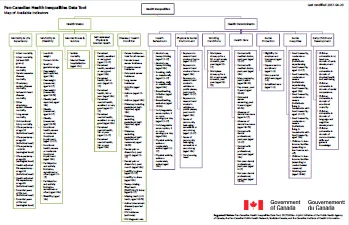
The Pan-Canadian Health Inequalities Reporting Initiative’s health inequalities data tool is a user-friendly, web-based tool that can be used to inform decisions relating to surveillance, research, programming and policies that address health inequities among population groups in Canada.

The purpose of this report is to showcase Canada’s recent actions that contribute to the commitments stated in the World Health Organization’s Rio Political Declaration on Social Determinants of Health .
The fifth, theme-based, annual report published by the Chief Public Health Officer of Canada focuses on sex-and gender-rooted health inequalities and what has been done and what can be done to address them.